
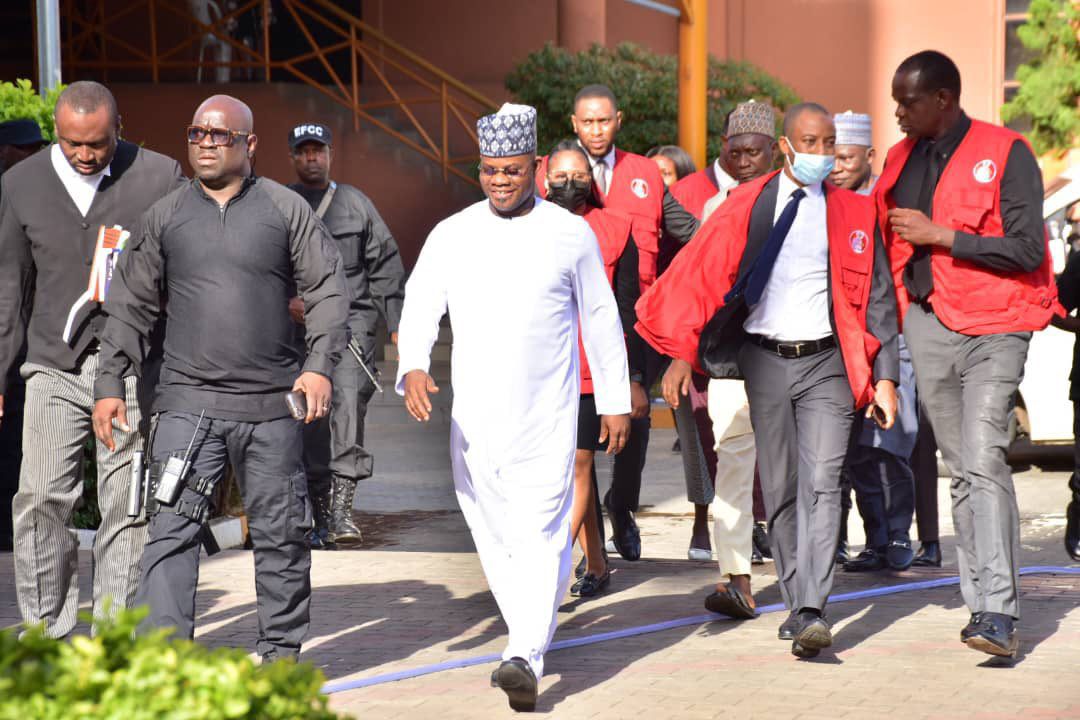
The Economic and Financial Crimes Commission (EFCC) has stated that public criticism and alleged harassment directed at the agency over delayed high-profile corruption trials—particularly the prosecution of former Kogi State Governor Yahaya Bello—are misplaced.
The commission’s spokesperson, Dele Oyewale, stated this during a joint press conference organized by the Office of the National Security Adviser (ONSA) in Abuja, bringing together public relations officers from military, security, and law enforcement agencies.
Responding to inquiries regarding procedural timelines in anti-graft prosecutions, Oyewale emphasized that the commission’s mandate is restricted to investigation and prosecution, leaving final adjudication exclusively within the jurisdiction of the courts.
“The EFCC as an anti-corruption agency is not the judiciary,” Oyewale said. “We cannot be the accuser and the judge in our own matter. Our mandate allows us to investigate, to prosecute, to prevent, but our mandate does not allow us to adjudicate. It is within the mandate and responsibility of the judiciary to decide when a matter is resolved or not”.
Addressing public scrutiny surrounding the former Kogi governor’s proceedings, Oyewale noted that the commission maintains a 98 percent prosecution success rate globally and should not be held accountable for judicial scheduling or procedural complexities inherent to financial crime trials.
“The issue of Yahaya Bello is always there. They continually harass us about Yahaya Bello. And we’ve charged the matter to court; the matter is in two different courts. We are going to court, and we wait for the judiciary to decide the matter,” he added.
The EFCC spokesperson further stated that the anti-graft body would reserve comments regarding campaign financing and electoral spending until the commencement of the official election period.